If you are like me, you will probably be a bit tired of reading my posts about eBook readers. At least, I have been a little tired of writing them! Don't panic, I hope this post is a little more interesting and I hope I have approached the topic from a slightly different angle this time. Anyhoo, here is a brief clip of me ranting about various aspects of eBooks. I hope you enjoy!
eBooks in Libraries? by neal_barber


19.8.11
Mining the Treasure Troves of New Zealand's Digital Content
Search: Legal Queers

This widget is set up to locate newspaper articles, photographs and "community content" using the string [Homosexual OR "Civil Union"]. One of the treasures unearthed is this photo from New Zealand History Online, an initiative of Manatū Taonga, Ministry of Culture and Heritage, of what appears to be worship of Sonja Davies:
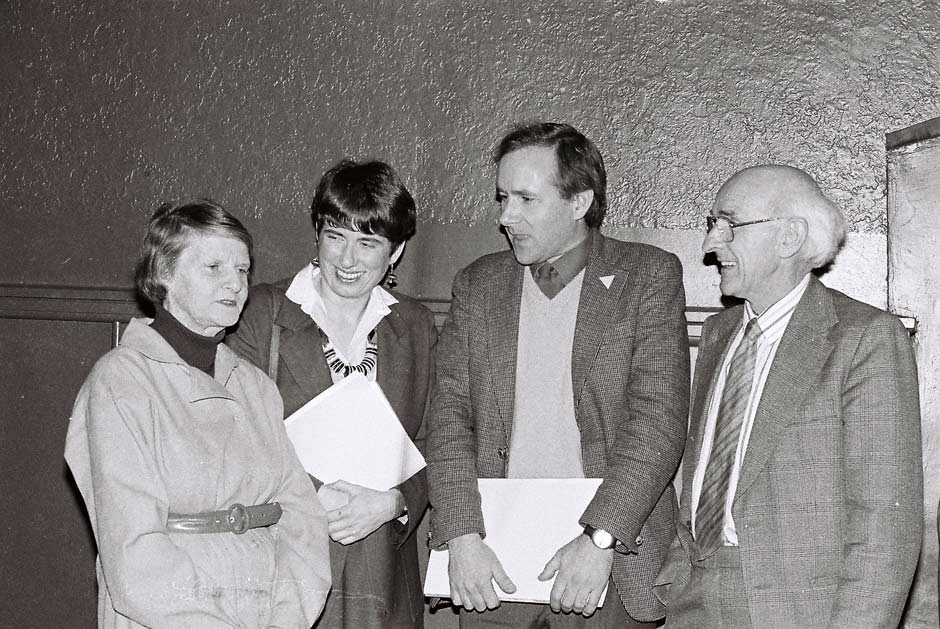 |
| Many public figures were drawn into groups supporting or opposing law reform. Here, reform supporters Sonja Davies (left) and Lloyd Geering (right) talk with the bill's sponsor, MP Fran Wilde, and Bill Logan of the Gay Task Force. Accessed from http://www.nzhistory.net.nz/media/photo/homosexual-law-reform-supporters. |
Of course, the amount of content that is available varies by subject to subject. Though, this is one of the strengths of the widget; DigitalNZ states that much of the content users can search is not available through search engines. Using this interface opens up access to content provided by people who are eager to get their content out there and used. The New-Zealand focus makes this content much more useful to both local and international communities who desire to use our content.
5.8.11
eBooks: LCD or eInk
There are two basic types of eBook reader currently available: LCD and eInk. Many of us will be familiar with LCD displays that are found on things such as cellphones, calculators, and laptops but we may not be so familiar with eInk - electrically charged particles moving in a liquid to display different images. Unless of course we have a Kindle, Kobo, Nook, or similar device.
As with any technology, there are a plethora of options available when looking for an eBook reader. Do I want one that allows me to read my books as well as function like a miniPC or do I want a reader that is dedicated to eBooks? Is a touch screen important? Is colour? Do I want to be able to annotate the books I read? All of these questions are reliant solely on personal taste to find a solution. Even more fundamentally: would I be better suited to using pBooks?
Personally, I find the difference between LCD screens and eInk is one of the most vital. Many of the comparisons between the two basic technologies state that eInk is not available in colour or can't handle video. Both of these statements now no longer hold with eInk's Triton, a colour eInk, and moving images are currently being produced, although they remain solely for retail displays. One advantage of eInk is that it uses less power since once an image is displayed it draws no power to keep displaying it whereas an LCD screen draws continual power. Some people also believe that an LCD screen gives them eyestrain - although there seems little evidence. I find that I remember what I read off paper to be easier to remember and this is also true with eInk. A further advantage of eInk is that it has a completely different "feel" to an LCD screen; reading can be a pleasurable activity that does not remind of work because it does not use the same technology to facilitate our reading.
Yet, for a library, the questions become much more difficult. Let's assume your library wants to provide eBooks. If you are also wishing to provide eReaders, you may want to consider which options are compatible with current subscriptions. Further, libraries need to consider legal issues since eBooks are covered by licences more than copyright. One important factor to consider our patrons' views. For example, do they want us to provide eBooks. With an estimated 5% of American adults owing an eBook reader, and such statistics growing rapidly, it seems as if there is such a market.
So, whether we are looking about eBooks for personal use or whether we are looking to incorporate them into our libraries there are many different options and we simply need to find the one that suits our needs.
 |
| The iPad - Apple's answer to an eBook reader |
 |
| Amazon's Kindle - just for books |
Personally, I find the difference between LCD screens and eInk is one of the most vital. Many of the comparisons between the two basic technologies state that eInk is not available in colour or can't handle video. Both of these statements now no longer hold with eInk's Triton, a colour eInk, and moving images are currently being produced, although they remain solely for retail displays. One advantage of eInk is that it uses less power since once an image is displayed it draws no power to keep displaying it whereas an LCD screen draws continual power. Some people also believe that an LCD screen gives them eyestrain - although there seems little evidence. I find that I remember what I read off paper to be easier to remember and this is also true with eInk. A further advantage of eInk is that it has a completely different "feel" to an LCD screen; reading can be a pleasurable activity that does not remind of work because it does not use the same technology to facilitate our reading.
Yet, for a library, the questions become much more difficult. Let's assume your library wants to provide eBooks. If you are also wishing to provide eReaders, you may want to consider which options are compatible with current subscriptions. Further, libraries need to consider legal issues since eBooks are covered by licences more than copyright. One important factor to consider our patrons' views. For example, do they want us to provide eBooks. With an estimated 5% of American adults owing an eBook reader, and such statistics growing rapidly, it seems as if there is such a market.
So, whether we are looking about eBooks for personal use or whether we are looking to incorporate them into our libraries there are many different options and we simply need to find the one that suits our needs.
7.6.11
Websites in Academic Research
It is the height of banality to state that the internet has fundamentally changed how we research; banality often hides truth. When young people get to be college age they usually have had extensive experience using the internet but often lack research skills. Much of our job as university-educators focuses on supplying these skills. One such skill is to use the internet for research or, more particularly, evaluating websites for use in academic research. Below is an example of a video designed to impart these skills:
10.11.10
Unit 1: A New Way
What is in This Unit?
And introduction to Web 2.0 using a brace of excellent videos.
Objective
By the end of this unit, a learner should:
Have a general understanding of what Web 2.0 is and what it means for how we live our lives.
Since about mid-2005, there has been a shift in how we use the internet for...well, pretty much everything really. The two videos below give some idea of the dramatic nature of this shift and what this shift potentially means for information literacy.
Tasks
Watch these videos and, in a blog, write a response to one or both. You may like to use the following questions as provocations for your posting:
And introduction to Web 2.0 using a brace of excellent videos.
Objective
By the end of this unit, a learner should:
Have a general understanding of what Web 2.0 is and what it means for how we live our lives.
Since about mid-2005, there has been a shift in how we use the internet for...well, pretty much everything really. The two videos below give some idea of the dramatic nature of this shift and what this shift potentially means for information literacy.
Tasks
Watch these videos and, in a blog, write a response to one or both. You may like to use the following questions as provocations for your posting:
- Do you think we really are using the internet in a different way?
- How do these videos relate to your experience of using technology?
- Why do you think there has been a sudden rise in popularity of social media?
- When was the first time you heard the phrase "Web 2.0" and how have you since related to the term?
- Do you feel the phrase is a good one? What might be a better term?
Subscribe to:
Posts (Atom)